
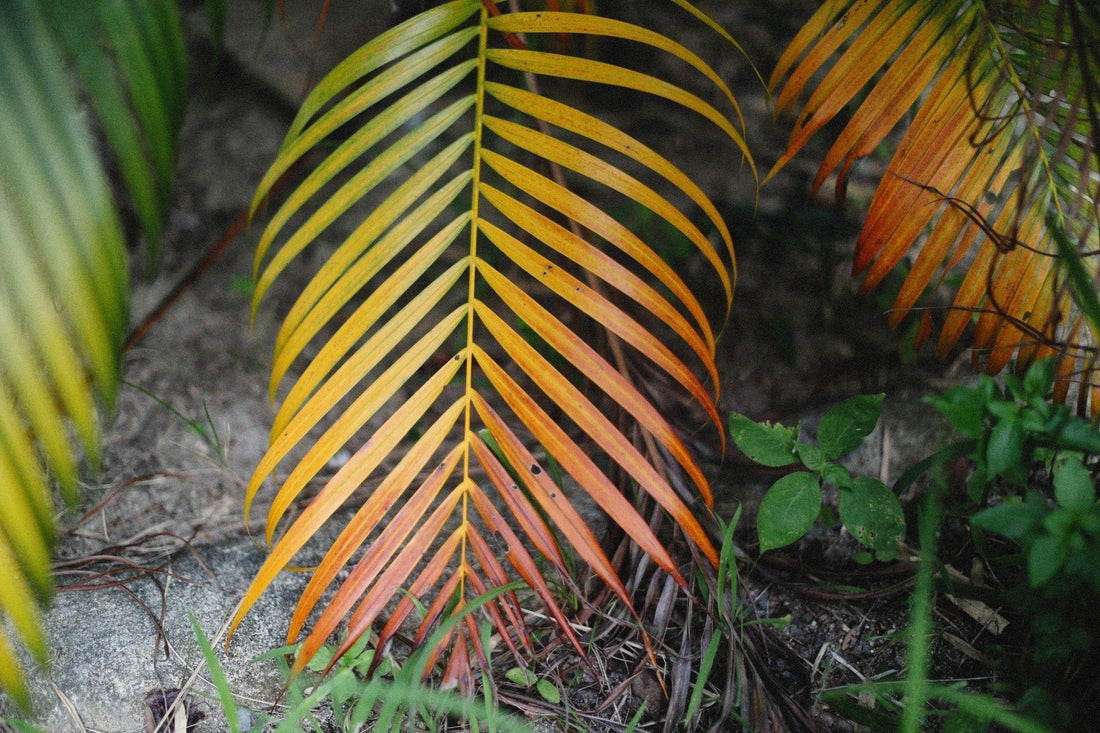
Walk through any Malaysian oil palm block and you will eventually spot fronds with a vivid orange-yellow discolouration. The immediate assumption is disease, viral infection, or pest damage. In most cases, the diagnosis is simpler and the fix is well within reach: magnesium deficiency, triggered by nutrient antagonism and soil conditions that many estates inadvertently create.
The diagnostic pattern that distinguishes Mg from other problems
Magnesium deficiency in oil palm follows a distinctive visual pattern. The bright orange colouration appears on the upper-rank pinnae exposed to direct sunlight, while shaded pinnae on the same frond stay green. This shading effect is a characteristic field indicator of Mg deficiency. The reason: magnesium is the central atom in the chlorophyll molecule. Sunlit tissue is under the greatest light stress, and when Mg is short, chlorophyll in those cells breaks down first, unmasking the carotenoids that give the characteristic orange colour.
Why high-potassium programmes cause magnesium deficiency
Potassium and magnesium compete for uptake at the root surface. When potassium application rates are high, leaf Mg concentrations can fall into the deficient range, and estates with heavy MOP (KCl) programmes that have not recalibrated their Mg applications are particularly vulnerable. Leaf analysis interpreted against your laboratory's critical levels shows whether this is happening.
Soils most at risk in Malaysia
Sandy coastal soils and inland Ultisols with low cation exchange capacity (CEC) hold little Mg against leaching, and Malaysia's high annual rainfall keeps leaching pressure on exchangeable soil Mg high. Peat soils present a different risk: K-Mg antagonism is often amplified by the high K loading of standard fertiliser programmes. SoilBoost EA, a humic soil conditioner, can be used alongside the corrective programme to help the soil hold nutrients; it does not supply magnesium itself.
The corrective programme
The usual corrective input for established oil palm is kieserite (MgSO4·H2O), applied where feeder roots concentrate, at a rate set from leaf and soil analysis by your agronomist. Kieserite is preferred over dolomitic limestone in corrective situations because it is water soluble and acts faster; dolomite is the better choice where soil acidity also needs correcting. On sandy or low-CEC soils, SoilBoost EA may help applied Mg stay in the root zone for longer, as part of a programme that also builds soil organic matter.
How to prevent recurrence
Recurrence can be prevented with three practices: leaf analysis at least once a year with leaf Mg as a standard parameter; K and Mg applications reviewed together rather than independently; and soil organic matter management, with composted materials and SoilBoost EA, to help the soil hold nutrients across seasons.
SoilBoost EA is a soil conditioner. It is not a fungicide, pesticide, plant protection product, or standalone treatment for Fusarium TR4, Phytophthora, or any crop disease. It may support soil structure and root-zone conditions as part of a broader agronomy programme, but disease management must follow local agronomist, regulatory, sanitation, drainage, and resistant-variety guidance.